# @save
import re
from dataclasses import dataclass

STOP = {
    "the", "a", "an", "to", "and", "or", "for", "of", "in", "on", "is", "it",
    "this", "that", "their", "them", "they", "our", "us", "we", "you", "your",
    "with", "but", "not", "yet", "if", "so", "do", "does", "did", "has", "have",
    "was", "are", "what", "when", "how", "out", "up", "about", "at", "by", "as",
    "customer", "order", "please", "want", "wants", "asking", "says", "find",
    "here", "should", "can", "be", "my", "me",
}


def terms(text: str) -> set[str]:
    """Reduce text to the content words a lexical matcher compares on.

    Lowercases, keeps alphabetic words longer than two characters, drops a small
    stopword list, and stems a few common suffixes so ``refunded`` and ``refund``
    match. It is deliberately crude: a production harness would embed text
    instead, but the crudeness makes every match in this chapter explainable.

    Args:
        text: A task phrase or a tool card to tokenize.

    Returns:
        The set of normalized content words.
    """
    def stem(word: str) -> str:
        for suffix in ("ing", "ed", "es", "s"):
            if len(word) > 4 and word.endswith(suffix):
                return word[: -len(suffix)]
        return word

    return {stem(w) for w in re.findall(r"[a-z]+", text.casefold())
if w not in STOP and len(w) > 2}17 Tool Engineering and Harness Design
Two teams wire the same model into a support console and get very different systems. The first exposes one run(command) tool that returns forty thousand characters of terminal output; its agent flails, retries, and occasionally moves money it should not. The second exposes order_status, policy_read, and refund_draft, each with a bounded schema and a concise result, confines files to a per-thread directory, runs any untrusted code under a resource limit, and makes a human approve refunds against the exact order state — with a re-check the instant before the money moves. Same weights, same prompt. The difference is the harness: the software that decides what the model can see, call, and cause.
We build that harness in this chapter, one measurable piece at a time, and we let the measurements drive the design. We tune a tool surface against a six-task eval and watch success climb from zero to one as the names and descriptions improve; we give each tool a schema and a risk rating; we retrieve a small tool set instead of preloading a catalog and plot the recall-versus-context trade; we assemble one model call through a context ledger that evicts a low-priority row when the budget overflows; we run hostile code inside a subprocess bounded by CPU and memory limits, and show the one escape a path check cannot stop; we package a procedure as a skill whose body loads only when a task activates it; and we bind a human approval to exact arguments and target state, then defeat a substituted-argument and a stale-target attack by revalidating at the last responsible moment. The through-line is the chapter’s thesis: the interface and the harness determine behavior as much as the weights do, and an approval that is not revalidated at execution time is theater. Chapter 16 supplies the loop this harness sits inside — model output is a proposal, never authority; here we build the walls that hold that proposal.
17.1 The interface is part of the intelligence
Start with the claim that interface design is a model-performance variable, and test it with numbers rather than assert it. This is the Agent–Computer Interface (ACI) thesis: the same model, given a better vocabulary of actions and observations, becomes a more capable agent (Yang et al. 2024). The model reads a small card for each tool — a name and a description — and must pick the right one for the task. If the cards are vague, selection fails before any code runs.
We need a stand-in for the model’s selection step. A real system embeds the task and the cards and ranks by similarity; we use a transparent lexical scorer so the reader can see exactly why a tool wins. It scores a tool by how many meaningful words the task and the card share, after dropping stopwords and light suffixes. This is a teaching probe, not a production retriever, and its transparency is the point — every decision it makes is inspectable.
A tool card is just the model-visible pair. We keep it separate from the full executable contract we build in the next section: the model chooses on the card, the application enforces on the contract.
# @save
@dataclass(frozen=True)
class ToolCard:
    """The model-visible summary of a tool: what the router reads to choose it.

    Only ``name`` and ``description`` reach the model at selection time. Keeping
    this small and honest is the whole ACI lever — a card that names its job and
    its exclusions is retrievable; a card called ``get`` is not.
    """

    name: str
    description: str


def route(task: str, cards: list[ToolCard]) -> int:
    """Pick the index of the card whose words best cover the task.

    Ties break toward the earlier card, deterministically, so a surface of
    indistinguishable cards collapses to always choosing the first one — which is
    exactly the failure a vague surface produces.

    Args:
        task: A user-intent phrase, in the user's words, not the tool's.
        cards: The candidate tool cards.

    Returns:
        The index into ``cards`` of the best match.
    """
    task_terms = terms(task)
    return max(
        range(len(cards)),
        key=lambda i: (len(task_terms & terms(f"{cards[i].name} {cards[i].description}")), -i),
    )
Now the eval. Six support tasks, each phrased the way a user would phrase it — not as a paraphrase of any tool’s description, which is what would make the test a tautology. Each task has one correct tool. Success is the fraction of tasks routed to the right tool.
tasks = [
    ("the package arrived broken and they want their money back", "refund_issue"),
    ("check whether this order has shipped yet", "order_status"),
    ("what is our return window", "policy_read"),
    ("note in the file that we called about the delay", "case_note_add"),
    ("is this buyer a premium member", "customer_tier"),
    ("start a refund but do not send the money yet", "refund_draft"),
]


def success(cards: list[ToolCard]) -> float:
    picks = [cards[route(task, cards)].name for task, _ in tasks]
    return sum(pick == expected for pick, (_, expected) in zip(picks, tasks)) / len(tasks)
The first surface is the grab-bag every codebase grows by accident: short generic verbs, descriptions that restate the name.
bad = [
    ToolCard("get", "get information"),
    ToolCard("do", "perform an action"),
    ToolCard("manage", "manage records"),
    ToolCard("lookup", "look something up"),
    ToolCard("update", "update a value"),
    ToolCard("run", "run a command"),
]
print(f"bad surface success = {success(bad):.2f}")
print("picks:", [bad[route(t, bad)].name for t, _ in tasks])
bad surface success = 0.00
picks: ['get', 'get', 'get', 'get', 'get', 'get']Every task routes to get, because no card shares any word with any task and the tie-break falls to the first. The model is not stupid; the surface gave it nothing to distinguish. Now rewrite each card as a specific verb–object name with a description that names the job.
good_v1 = [
    ToolCard("refund_issue", "issue an approved refund and send money back to the original payment method"),
    ToolCard("order_status", "look up whether an order has shipped and its tracking and delivery state"),
    ToolCard("policy_read", "read the refund and returns policy including the return window and eligibility"),
    ToolCard("case_note_add", "write a note into the support case file recording what happened"),
    ToolCard("customer_tier", "look up the buyer membership tier and premium status"),
    ToolCard("refund_draft", "draft a refund for review without sending money"),
]
print(f"good v1 success = {success(good_v1):.2f}")
picks = [good_v1[route(t, good_v1)].name for t, _ in tasks]
for (task, expected), pick in zip(tasks, picks):
    flag = "" if pick == expected else "   <- wrong tool"
    print(f"  {pick:14} {flag}")
good v1 success = 0.83
refund_issue
order_status
policy_read
case_note_add
customer_tier
refund_issue <- wrong toolSuccess jumps to 0.83, but one task still routes wrong: “start a refund but do not send the money yet” picks refund_issue, not refund_draft. Both cards say “refund”; the request’s real intent — do not send money — is the exclusion that separates them, and neither card encodes it. This is the wrong-tool case a real eval exists to catch, and it points at the fix.
good_v2 = list(good_v1)
good_v2[0] = ToolCard("refund_issue",
                      "issue an approved refund that actually sends money; do not use to draft or propose")
good_v2[5] = ToolCard("refund_draft",
                      "draft or propose a refund for review without sending money yet; start but do not send")
print(f"good v2 success = {success(good_v2):.2f}")
good v2 success = 1.00Two edited descriptions — adding the do not send / actually sends money boundary — take success to 1.0. Nothing about the model changed. We iterated the interface against an eval and read the capability back out, which is the entire loop this chapter keeps returning to. Figure 17.1 shows the three measurements side by side.
Show the code that draws this figure
import matplotlib.pyplot as plt

surfaces = {"bad\n(generic)": success(bad), "good v1\n(specific)": success(good_v1),
            "good v2\n(+exclusions)": success(good_v2)}
fig, ax = plt.subplots(figsize=(6.2, 3.2))
bars = ax.bar(list(surfaces), list(surfaces.values()), color=["#b13f3f", "#c9a227", "#2a7f4f"])
ax.bar_label(bars, labels=[f"{v:.2f}" for v in surfaces.values()], padding=3)
ax.set_ylim(0, 1.1)
ax.set_ylabel("tool-selection success (6 tasks)")
ax.spines[["top", "right"]].set_visible(False)
fig.tight_layout()
plt.show()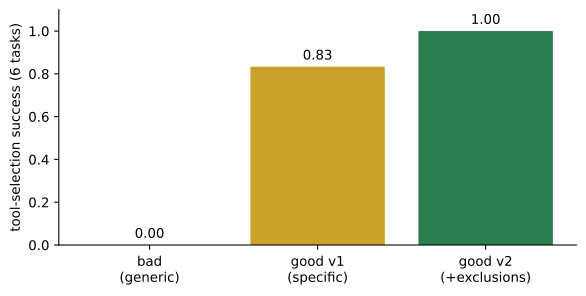
The lesson generalizes into a contract every tool should satisfy: name one job with a specific verb and object; say when to use it and when not to; type its arguments; declare the authority it exercises; return a concise structured result; and make success verifiable from that result rather than from a reassuring sentence. The next section turns the last four of those into code.
17.2 One tool contract, and its risk rating
The card is what the model reads; the contract is what the application enforces. It adds three things the card omits: a typed argument schema, a risk rating, and the handler that actually runs. Separating risk from arguments lets the harness decide at discovery time — before it inspects a single argument — whether a call needs a budget, a sandbox, or a human. We use a two-value rating to expose the mechanism; production needs data-sensitivity and resource-impact axes too, because a “read” that exports regulated data is not low-risk merely because it leaves state unchanged.
# @save
from enum import Enum
from typing import Any, Callable


class Risk(str, Enum):
    """Whether a tool observes state or changes it — the discovery-time split.

    READ tools can run freely; WRITE tools must clear an approval before the
    handler fires. The rating is a property of the tool, known before arguments
    are seen, so the harness can assign gates and budgets at selection time
    rather than parsing every call first.
    """

    READ = "read"
    WRITE = "write"


@dataclass(frozen=True)
class Tool:
    """A model-facing card bound to an application-owned handler and risk class.

    ``target_version`` is not shown to the model. It lets the harness ask the
    application "is this resource still the one a human reviewed?" at execution
    time, which is what makes the approval binding in a later section possible.
    """

    name: str
    summary: str
    schema: dict[str, type]
    risk: Risk
    handler: Callable[..., Any]
    target_version: Callable[[dict[str, Any]], str] | None = None
A proposed call and the authenticated context that surrounds it are separate values. The model supplies the call; the application supplies the tenant and actor. The model never names its own authority.
# @save
@dataclass(frozen=True)
class Call:
    """One exact proposed invocation: which tool, with which arguments."""

    tool: str
    arguments: dict[str, Any]


@dataclass(frozen=True)
class ExecutionContext:
    """Authenticated identity supplied by the application, never by the model."""

    tenant_id: str
    actor_id: str
Before any tool runs, its arguments are validated against the schema. A malformed call is a typed rejection the agent can react to, not an exception that unwinds the loop. The model should never learn argument legality from a stack trace.
# @save
def validate_call(call: Call, tool: Tool) -> None:
    """Reject a call whose arguments do not match the tool's typed schema.

    Checks the argument names exactly (no missing, no extra) and each value's
    type. Raising a precise ``ValueError`` gives the harness a repairable signal
    to hand back to the model instead of a crash.

    Args:
        call: The proposed invocation to check.
        tool: The contract whose schema the call must satisfy.

    Raises:
        ValueError: If argument names or types do not match the schema.
    """
    if set(call.arguments) != set(tool.schema):
        raise ValueError(f"expected fields {sorted(tool.schema)}")
    for name, expected in tool.schema.items():
        if not isinstance(call.arguments[name], expected):
            raise ValueError(f"{name} must be {expected.__name__}")
We build the six-tool surface around one mutable order and check that validation catches a wrong-typed argument. The refund_issue tool is the only WRITE; it carries a target_version so the harness can later detect a changed order.
order = {"status": "damaged", "version": "v1", "refunded_cents": 0}


def issue_refund(order_id: str, amount_cents: int) -> dict[str, Any]:
    order["refunded_cents"] = amount_cents
    order["version"] = f"v{int(order['version'][1:]) + 1}"
    return {"order_id": order_id, "refunded_cents": amount_cents}


tools = {
    "order_status": Tool("order_status", "look up order shipping state",
                         {"order_id": str}, Risk.READ, lambda order_id: dict(order)),
    "refund_draft": Tool("refund_draft", "draft a refund without effect",
                         {"order_id": str, "amount_cents": int}, Risk.READ,
                         lambda order_id, amount_cents: {"order_id": order_id, "proposed_cents": amount_cents}),
    "refund_issue": Tool("refund_issue", "issue an approved refund",
                         {"order_id": str, "amount_cents": int}, Risk.WRITE, issue_refund,
                         target_version=lambda args: order["version"]),
}

valid_call = Call("refund_issue", {"order_id": "A-17", "amount_cents": 4999})
typo_call = Call("refund_issue", {"order_id": "A-17", "amount_cents": "lots"})
validate_call(valid_call, tools["refund_issue"])
print("valid call accepted")
try:
    validate_call(typo_call, tools["refund_issue"])
except ValueError as exc:
    print("rejected:", exc)
valid call accepted
rejected: amount_cents must be intGranularity is a design choice, not a preference for smaller functions. A tool should represent one domain decision whose preconditions and outcome can be explained. set_account_state(state) is too broad, because the model has to synthesize hidden business rules to use it; a separate tool for every internal row update is too narrow, because the model must coordinate a transaction it cannot observe atomically. suspend_account(reason, evidence_ids) is often the right seam: application code validates the evidence, runs the transaction, and returns the resulting account version. Retry semantics ride along with the risk class. A pure read can be retried freely; a write needs an idempotency or reconciliation contract, and the model must not infer retry legality from a natural-language error. The handler returns a typed category and code applies the policy — the same separation the approval section makes for authority.
The contract now knows each tool’s job, argument types, risk class, and retry rules before it ever runs. That risk class is what the approval and sandbox sections key on. First, though, we deal with a surface too large to show the model all at once.
17.3 Search the tool surface, or hand over a code runner
Six tools fit in a prompt. Six hundred do not, and a large menu also breeds selection errors: the more near-synonyms the model sees, the more often it picks the wrong one. Two patterns handle scale. The first keeps typed tools but retrieves a small candidate set per task instead of preloading the catalog. The retrieval objective is recall — missing the needed tool makes the task impossible, while one extra plausible tool costs only a little context — so we measure recall at k and the characters exposed.
# @save
def select_tools(query: str, tools: list[Tool], k: int = 3) -> list[Tool]:
    """Retrieve the k tools whose card best matches a task query.

    Ranks by shared content words between the query and each tool's name and
    summary, breaking ties toward earlier tools. Recall-oriented: raising k
    trades exposed context for a better chance the needed tool is present.

    Args:
        query: The task in user-intent language.
        tools: The full catalog to rank.
        k: How many tools to expose to the model.

    Returns:
        The top-k tools, most relevant first.
    """
    query_terms = terms(query)
    ranked = sorted(
        range(len(tools)),
        key=lambda i: (len(query_terms & terms(f"{tools[i].name} {tools[i].summary}")), -i),
        reverse=True,
    )
    return [tools[i] for i in ranked[:k]]
We build a ten-tool catalog and six queries whose target tool is known, then sweep k.
catalog = [
    Tool("refund_issue", "issue an approved refund and send money to the original payment method", {}, Risk.WRITE, lambda: None),
    Tool("order_status", "check whether an order shipped and its delivery tracking", {}, Risk.READ, lambda: None),
    Tool("policy_read", "read the returns policy and the refund window rules", {}, Risk.READ, lambda: None),
    Tool("case_note_add", "record a note in the support case file", {}, Risk.WRITE, lambda: None),
    Tool("customer_tier", "look up the buyer membership tier and premium status", {}, Risk.READ, lambda: None),
    Tool("refund_draft", "draft a refund for review without sending money", {}, Risk.READ, lambda: None),
    Tool("invoice_send", "email an invoice or receipt to the buyer", {}, Risk.WRITE, lambda: None),
    Tool("address_update", "change the shipping address on an open order", {}, Risk.WRITE, lambda: None),
    Tool("subscription_cancel", "cancel a recurring subscription and stop future billing", {}, Risk.WRITE, lambda: None),
    Tool("ticket_escalate", "escalate the case to a senior agent or supervisor", {}, Risk.READ, lambda: None),
]
queries = [
    ("the buyer wants money back for a broken item", "refund_issue"),
    ("where is my package it has not arrived", "order_status"),
    ("how long do i have to return something", "policy_read"),
    ("log what we discussed on the call", "case_note_add"),
    ("does this account have premium benefits", "customer_tier"),
    ("stop billing me every month", "subscription_cancel"),
]


def surface_chars(tools: list[Tool]) -> int:
    return sum(len(t.name) + len(t.summary) for t in tools)


preload = surface_chars(catalog) * len(queries)
for k in (1, 2, 3):
    hits = sum(exp in {t.name for t in select_tools(q, catalog, k)} for q, exp in queries)
    exposed = sum(surface_chars(select_tools(q, catalog, k)) for q, _ in queries)
    print(f"recall@{k} = {hits/len(queries):.2f}   exposed_chars = {exposed:4d}   (preload all = {preload})")
recall@1 = 0.67 exposed_chars = 447 (preload all = 3810)
recall@2 = 0.83 exposed_chars = 894 (preload all = 3810)
recall@3 = 0.83 exposed_chars = 1281 (preload all = 3810)Recall climbs from 0.67 at k=1 to 0.83 at k=3, while exposed characters stay far under the 3,810 it costs to preload the whole catalog on every task. The curve is the trade: more context buys more recall, with diminishing returns, and here it plateaus at 0.83 because one query shares no word with its target tool — a lexical ceiling a real embedding retriever would push higher. Figure 17.2 plots both axes.
Show the code that draws this figure
ks = [1, 2, 3, 4, 5]
recalls = [sum(exp in {t.name for t in select_tools(q, catalog, k)} for q, exp in queries) / len(queries) for k in ks]
exposed = [sum(surface_chars(select_tools(q, catalog, k)) for q, _ in queries) for k in ks]
fig, ax1 = plt.subplots(figsize=(6.4, 3.3))
ax1.plot(ks, recalls, marker="o", color="#2a7f4f", label="recall@k")
ax1.set_xlabel("tools retrieved per task (k)")
ax1.set_ylabel("recall", color="#2a7f4f")
ax1.set_ylim(0, 1.05)
ax2 = ax1.twinx()
ax2.plot(ks, exposed, marker="s", color="#315b8a", label="exposed chars")
ax2.axhline(preload, ls="--", color="0.6")
ax2.set_ylabel("exposed characters", color="#315b8a")
ax1.set_xticks(ks)
fig.tight_layout()
plt.show()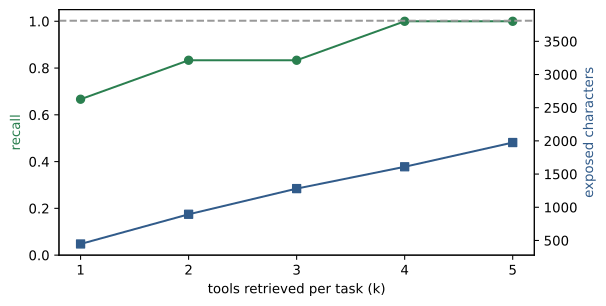
The second pattern goes further: instead of exposing many tool schemas, expose one code-execution tool and let the model write a short program that calls internal APIs. This collapses N schemas to one and lets the model compose filtering, aggregation, and control flow in a single turn — but it moves the entire burden onto sandboxing, because now the model’s output is arbitrary code. That trade is only safe if the harness can bound what the code does, which is the mechanism we build next.
17.4 Assemble context with a ledger
Retrieved tools are one contributor to a model call. So are stable instructions, the task, compacted history, activated skills, retrieved evidence, and recent observations. Without accounting, whichever component appends last silently wins the remaining window. A context ledger turns that invisible string into an inspectable artifact: each row records its source, token cost, trust class, and admission priority, and admission is a budget decision we can watch.
Let the usable window be W, the reserved output allowance be R, and the selected components have token counts n_i. Admission requires
\sum_i n_i \le W - R. \tag{17.1}
The inequality is simple; the policy is deciding which rows survive when it does not hold. We admit by ascending priority — the safety contract and current task first, older history last — until the budget is spent.
# @save
@dataclass(frozen=True)
class LedgerRow:
    """One accounted contribution to a model call.

    Trust class travels with the row because two equally sized components can
    carry different injection risk; priority is the admission order, lowest
    first, so hard requirements are never evicted for stale evidence.
    """

    source: str
    tokens: int
    trust: str
    priority: int


class ContextLedger:
    """An inspectable budget over the components of one model call.

    Records every candidate row and, given a window and an output reserve,
    admits rows by ascending priority until the budget in @eq-ch17-admission is
    spent. The rows it evicts are the testable answer to "why did the model not
    see the policy?" — the question an invisible prompt string cannot answer.
    """

    def __init__(self, window: int, reserve: int) -> None:
        self.budget = window - reserve
        self.rows: list[LedgerRow] = []

    def add(self, row: LedgerRow) -> None:
        """Register a candidate component; admission happens in :meth:`assemble`."""
        self.rows.append(row)

    def assemble(self) -> tuple[list[LedgerRow], list[LedgerRow]]:
        """Admit rows by priority within budget, returning (admitted, evicted).

        Returns:
            Two lists: the rows that fit the budget, lowest priority first, and
            the rows evicted because the running total would exceed it.
        """
        used, admitted, evicted = 0, [], []
        for row in sorted(self.rows, key=lambda r: r.priority):
            if used + row.tokens <= self.budget:
                used += row.tokens
                admitted.append(row)
            else:
                evicted.append(row)
        return admitted, evicted
We fill a ledger for a 1,200-token window reserving 300 for output, then print what it admits and what it drops.
ledger = ContextLedger(window=1200, reserve=300)
for row in [
    LedgerRow("safety_contract", 120, "authoritative", 0),
    LedgerRow("task", 80, "user", 0),
    LedgerRow("tool_schemas", 300, "authoritative", 1),
    LedgerRow("recent_observations", 250, "tool", 1),
    LedgerRow("retrieved_policy", 140, "retrieved", 2),
    LedgerRow("old_history", 400, "user", 3),
]:
    ledger.add(row)

admitted, evicted = ledger.assemble()
print(f"budget = {ledger.budget} tokens, used = {sum(r.tokens for r in admitted)}")
for row in admitted:
    print(f"  admit  {row.source:20} {row.tokens:4d}  [{row.trust}]")
for row in evicted:
    print(f"  EVICT  {row.source:20} {row.tokens:4d}  [{row.trust}]")
budget = 900 tokens, used = 890
admit safety_contract 120 [authoritative]
admit task 80 [user]
admit tool_schemas 300 [authoritative]
admit recent_observations 250 [tool]
admit retrieved_policy 140 [retrieved]
EVICT old_history 400 [user]The window holds everything except old_history, the lowest-priority row, which is evicted rather than allowed to crowd out the safety contract. When an agent later fails because it lacked history, the ledger names the cause — and a counterfactual replay with old_history raised in priority tests the fix. Figure 17.3 draws the budget bar with the evicted row hatched beyond the line.
Show the code that draws this figure
fig, ax = plt.subplots(figsize=(6.6, 2.2))
left = 0
colors = {"authoritative": "#2a7f4f", "user": "#315b8a", "tool": "#7a5195", "retrieved": "#c9a227"}
for row in admitted:
    ax.barh(0, row.tokens, left=left, color=colors[row.trust], edgecolor="white")
    ax.text(left + row.tokens / 2, 0, row.source.split("_")[0], ha="center", va="center", fontsize=7, color="white")
    left += row.tokens
for row in evicted:
    ax.barh(0, row.tokens, left=left, color="0.8", hatch="//", edgecolor="0.5")
    ax.text(left + row.tokens / 2, 0, f"EVICT\n{row.source.split('_')[0]}", ha="center", va="center", fontsize=7)
    left += row.tokens
ax.axvline(ledger.budget, color="#b13f3f", lw=2)
ax.text(ledger.budget, 0.6, " budget", color="#b13f3f", va="center", fontsize=8)
ax.set_yticks([])
ax.set_xlabel("tokens")
ax.set_ylim(-0.6, 0.9)
fig.tight_layout()
plt.show()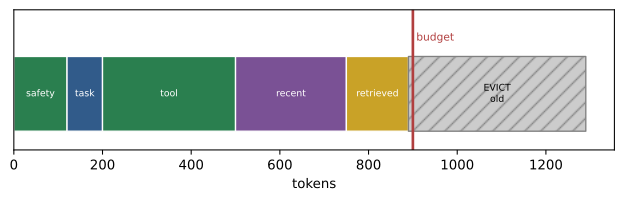
The trust column is not decoration. Two rows of equal token cost can carry very different injection risk: an authoritative safety contract and a chunk of retrieved third-party text are not interchangeable even when they weigh the same, and the label lets the policy layer treat them differently and the trace analysis in Chapter 24 reason about which tokens could have steered a decision. Token count alone would hide that. The ledger also turns a vague post-mortem into an experiment: “the model got confused by context” becomes a counterfactual replay with one row removed, an earlier snapshot substituted, or the ordering changed, and the divergent output names the culprit.
Ordering also interacts with prefix caches: stable content near the front, volatile state later, so a fresh timestamp does not invalidate reuse of the whole prompt. The ledger records those choices without re-teaching serving. With context accounted for, we turn to the boundary that contains what tools actually do.
17.5 A workspace boundary, and a real sandbox
Longer tasks need files: notes, patches, downloaded pages, test reports. A per-thread workspace gives them stable names and separates one run from another. The smallest useful rule resolves every requested path against one owned root and rejects anything outside it.
# @save
from pathlib import Path


class Workspace:
    """Name-scope files to one thread root; this is naming, not containment.

    ``resolve`` blocks ``../`` traversal and absolute-path escapes through this
    API. It does not stop a process that opens another path directly — that
    needs the execution sandbox below. Naming containment and execution
    containment are separate guarantees, and a secure harness uses both.
    """

    def __init__(self, root: Path) -> None:
        self.root = root.resolve()

    def resolve(self, relative: str) -> Path:
        """Return a path inside the root, or reject an escape.

        Args:
            relative: A path expressed relative to the workspace root.

        Returns:
            The resolved absolute path, guaranteed under the root.

        Raises:
            PermissionError: If the resolved path escapes the workspace root.
        """
        candidate = (self.root / relative).resolve()
        if not candidate.is_relative_to(self.root):
            raise PermissionError(f"path escapes workspace: {relative}")
        return candidate
Path resolution is naming, not execution containment. The moment a tool runs untrusted code — the code-execution pattern from the last section, or any subprocess a tool spawns — we need to bound its CPU, memory, and time so a runaway or hostile snippet cannot take the host down. On Linux the kernel gives us that directly: a child process with resource limits set before exec. Here is a restricted executor that runs code in an isolated subprocess under a CPU-second and address-space cap, with a wall-clock timeout as a backstop.
# @save
import subprocess
import sys


def run_restricted(code: str, *, cpu_seconds: int = 1, mem_mb: int = 256,
                   timeout: float = 5.0) -> dict[str, str]:
    """Run untrusted Python in a subprocess bounded by kernel resource limits.

    Sets ``RLIMIT_CPU`` and ``RLIMIT_AS`` in the child before ``exec`` so a busy
    loop is killed by the kernel and an allocation bomb fails with MemoryError,
    with a wall-clock timeout as a final backstop. This is the execution
    containment a workspace path check cannot provide.

    Args:
        code: Python source to execute in isolation.
        cpu_seconds: CPU-time limit; exceeding it kills the child by signal.
        mem_mb: Address-space limit in megabytes.
        timeout: Wall-clock backstop in seconds.

    Returns:
        A dict with ``status`` in {ok, killed, error} and a short ``detail``.
    """
    import resource

    def apply_limits() -> None:
        resource.setrlimit(resource.RLIMIT_CPU, (cpu_seconds, cpu_seconds))
        soft = mem_mb * 1024 * 1024
        resource.setrlimit(resource.RLIMIT_AS, (soft, soft))

    try:
        proc = subprocess.run([sys.executable, "-I", "-c", code], preexec_fn=apply_limits,
                              capture_output=True, text=True, timeout=timeout)
    except subprocess.TimeoutExpired:
        return {"status": "killed", "detail": "wall-clock timeout"}
    if proc.returncode < 0:
        return {"status": "killed", "detail": "resource limit"}
    if proc.returncode != 0:
        last = proc.stderr.strip().splitlines()[-1] if proc.stderr.strip() else "nonzero exit"
        return {"status": "error", "detail": last}
    return {"status": "ok", "detail": proc.stdout.strip()}
We run three snippets: a benign computation, an infinite loop, and an allocation bomb.
print("benign :", run_restricted("print(sum(range(1000)))"))
print("cpu    :", run_restricted("while True: pass"))
print("memory :", run_restricted("x = bytearray(400 * 1024 * 1024)"))
benign : {'status': 'ok', 'detail': '499500'}
cpu : {'status': 'killed', 'detail': 'resource limit'}
memory : {'status': 'error', 'detail': 'MemoryError'}The benign call returns its output; the busy loop is killed by the CPU limit; the allocation bomb dies with MemoryError under the address-space cap. This is the containment that makes the one-code-tool pattern from the previous section concrete. Instead of exposing separate list_orders, filter_by_state, and sum_amounts tools and having the model orchestrate three round-trips, we expose one code tool and let the model write the aggregation once. We embed the data and run the snippet under the same limits.
orders = [{"id": "A-17", "cents": 4999, "state": "shipped"},
          {"id": "A-18", "cents": 1200, "state": "pending"},
          {"id": "A-19", "cents": 3050, "state": "shipped"}]
snippet = (f"orders = {orders!r}\n"
           "print(sum(o['cents'] for o in orders if o['state'] == 'shipped'))")
print("one code tool, three tools' worth of work:", run_restricted(snippet))
one code tool, three tools' worth of work: {'status': 'ok', 'detail': '8049'}The model expressed a filter-and-sum in one turn, and the sandbox bounded it — that is the whole trade: the code tool collapses the schema surface but only pays off if the executor holds. It is also how we would run any subprocess a tool spawns. But resource limits are not filesystem or network containment. The next snippet, run under the very same limits, reads a file far outside any workspace — and succeeds.
escape = run_restricted("import os; print(os.path.exists('/etc/hostname'))")
print("filesystem escape :", escape)
filesystem escape : {'status': 'ok', 'detail': 'True'}The executor bounds CPU and memory, so the read completes and prints True: the sandbox never contained the filesystem. Workspace.resolve would have rejected /etc/hostname through its API, but the subprocess never called that API — it opened the path directly. Closing this gap needs filesystem namespaces or a container, not a longer path check. Figure 17.4 separates what each layer covers.
flowchart TB
    Code["Untrusted tool code / model-written snippet"]
    Code --> Name["Workspace.resolve()"]
    Code --> RL["run_restricted() — RLIMIT_CPU / RLIMIT_AS / timeout"]
    Name -->|covered| Paths["'../escape' path names"]
    RL -->|covered| Busy["busy loops, memory bombs"]
    RL -.->|NOT covered| Escape["open('/etc/hostname'), network egress, credentials"]
    Escape --> NS["needs filesystem namespaces / container / seccomp"]
The invariant to carry forward: a workspace establishes naming, a resource limit establishes compute bounds, and neither establishes filesystem or network isolation. A secure harness composes all three. We now package a reusable procedure that these boundaries will constrain.
17.6 Skills as progressively disclosed procedures
A tool supplies an action; a skill supplies procedural knowledge — when to use which tools, in what order, what to check. Loading every skill’s instructions into every prompt taxes every task with procedures it will not use. The durable fix is progressive disclosure in three levels: cheap metadata (a name and a description) stays resident so the harness can index broadly; the instructions load only when a task activates the skill; and resources — scripts, templates, reference data — load only when a step needs them.
We write a real skill to disk: a SKILL.md with front-matter metadata, an instructions body, and one resource file.
import tempfile

skill_dir = Path(tempfile.mkdtemp()) / "refund-investigation"
skill_dir.mkdir(parents=True)
(skill_dir / "SKILL.md").write_text(
    "---\n"
    "name: refund-investigation\n"
    "description: investigate whether a refund is allowed by checking order state "
    "payment and the returns policy window; use for refund eligibility questions\n"
    "exclude: shipping address changes; subscription cancellations\n"
    "---\n"
)
(skill_dir / "instructions.md").write_text(
    "1. read the order status and payment state\n"
    "2. read the returns policy window\n"
    "3. compare the purchase date against the window\n"
    "4. if eligible, draft a refund for human review\n"
    "5. never issue a refund without approval\n"
)
(skill_dir / "eligibility.txt").write_text("window_days=30\nrestocking_fee_cents=0\n")
print("skill files:", sorted(p.name for p in skill_dir.iterdir()))
skill files: ['SKILL.md', 'eligibility.txt', 'instructions.md']The loader reads only what a level needs. Metadata parsing touches the front-matter alone; the body and resources are separate reads gated on demand.
# @save
class SkillCard:
    """A skill's always-resident metadata plus lazy access to deeper levels.

    Level 1 (name, triggers, exclusions) is parsed at construction and is the
    only text the harness keeps resident. Level 2 (instructions) and level 3
    (resources) are read from disk only when :meth:`instructions` or
    :meth:`resource` is called, which is progressive disclosure in one object.
    """

    def __init__(self, root: Path) -> None:
        self.root = root
        front = (root / "SKILL.md").read_text().split("---")[1]
        self.name = re.search(r"name:\s*(.+)", front).group(1).strip()
        self.description = re.search(r"description:\s*(.+)", front).group(1).strip()
        self.exclude = re.search(r"exclude:\s*(.+)", front).group(1).strip()
        self.metadata_chars = len((root / "SKILL.md").read_text())

    def activates_on(self, task: str) -> bool:
        """Decide whether a task should load this skill.

        Fires when the task shares a content word with the description and none
        with the exclusions. The exclusion check is what stops a naive matcher
        from activating on the boundary terms a good description spells out.

        Args:
            task: The user-intent phrase to classify.

        Returns:
            True if the skill's instructions should be disclosed for this task.
        """
        task_terms = terms(task)
        return bool(task_terms & terms(self.description)) and not (task_terms & terms(self.exclude))

    def instructions(self) -> str:
        """Disclose level 2: read the instructions body from disk on demand."""
        return (self.root / "instructions.md").read_text()
Before activation only metadata is resident. We show the disclosure decision on one task, and how many characters each level costs.
card = SkillCard(skill_dir)
print(f"resident metadata: {card.metadata_chars} chars")
print("activates on 'can this order be refunded'? ", card.activates_on("can this order be refunded"))
print("activates on 'change the shipping address'?", card.activates_on("change the shipping address"))
loaded = card.instructions()
print(f"on activation, instructions add {len(loaded)} chars")
resident metadata: 250 chars
activates on 'can this order be refunded'? True
activates on 'change the shipping address'? False
on activation, instructions add 214 charsThe description fires the skill; the excluded task — a shipping-address change — does not, even though “address” appears in the exclusion clause, because the classifier subtracts exclusion matches. A skill description is an activation classifier, so we score it on labeled cases: six tasks that should activate, six that should not.
positives = [
    "can this order be refunded", "is the buyer eligible for a refund",
    "check the refund window for this purchase", "does this refund fall inside the returns policy",
    "is a refund allowed here", "the buyer wants money back for a defect",
]
negatives = [
    "change the shipping address", "cancel my subscription", "where is my package",
    "escalate to a supervisor", "email me the invoice", "reset my password",
]
tp = sum(card.activates_on(t) for t in positives)
fp = sum(card.activates_on(t) for t in negatives)
fn = len(positives) - tp
print(f"precision = {tp/(tp+fp):.2f}   recall = {tp/(tp+fn):.2f}   (tp={tp} fp={fp} fn={fn})")
for t in positives:
    if not card.activates_on(t):
        print("  honest miss:", t)
precision = 1.00 recall = 0.83 (tp=5 fp=0 fn=1)
honest miss: the buyer wants money back for a defectPrecision is 1.0 and recall is 0.83: no false activation, but one positive — “the buyer wants money back for a defect” — is missed because it shares no word with the description. That miss is the same lesson as the wrong-tool case: activation quality is description quality, and it is measurable. Figure 17.5 shows the three disclosure levels’ cumulative cost.
Show the code that draws this figure
levels = ["metadata\n(resident)", "+ instructions\n(on activation)", "+ resource\n(on step need)"]
resource_chars = len((skill_dir / "eligibility.txt").read_text())
cumulative = [card.metadata_chars, card.metadata_chars + len(loaded),
              card.metadata_chars + len(loaded) + resource_chars]
fig, ax = plt.subplots(figsize=(6.2, 3.0))
bars = ax.bar(levels, cumulative, color=["#2a7f4f", "#c9a227", "#b13f3f"])
ax.bar_label(bars, labels=[f"{c} chars" for c in cumulative], padding=3)
ax.set_ylabel("cumulative characters loaded")
ax.spines[["top", "right"]].set_visible(False)
fig.tight_layout()
plt.show()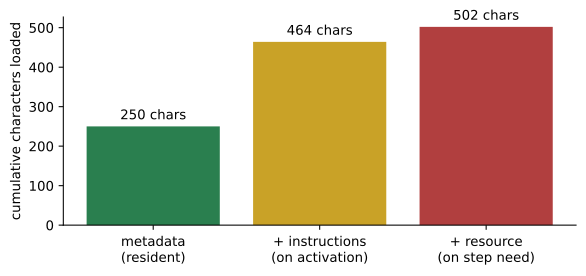
A skill is code-adjacent supply chain: version it, declare its tools, pin its resources, and record the activated version in the trace. Progressive disclosure reduces context load; it does not make a skill trustworthy — a malicious skill can instruct the model to read secrets, which is why the tool gates and the sandbox still constrain whatever the skill proposes. We turn now to the gate that stands between a proposal and an irreversible effect.
17.7 Human approval, revalidated at the last moment
“Ask a human before dangerous actions” sounds precise until the system has to pause. What exactly did the person approve? Was the target still in the reviewed state when the action ran? Could the model change the arguments afterward? A time-of-check to time-of-use (TOCTOU) failure is the gap between the state a human reviewed and the state the handler used. The model may substitute an argument; another process may change the order; the approval may expire. The defense is to bind the approval to exact values and revalidate at the last responsible moment — recompute the digests immediately before the handler runs.
We bind two digests: an action digest over the tool, canonical arguments, and authenticated identity, and a target digest over the resource version the human saw. Canonical serialization makes the hashes stable.
# @save
import hashlib
import json
import time


def _canonical(value: Any) -> bytes:
    """Serialize a value deterministically so its hash is stable."""
    return json.dumps(value, sort_keys=True, separators=(",", ":")).encode()


def _digest(value: Any) -> str:
    """Hash a canonical value for binding and comparison."""
    return hashlib.sha256(_canonical(value)).hexdigest()


def action_digest(call: Call, context: ExecutionContext) -> str:
    """Bind a proposal to its exact tool, arguments, tenant, and actor.

    Any change to the arguments or the authenticated identity changes this
    digest, which is what lets execution-time revalidation detect a substituted
    action that a human never reviewed.

    Args:
        call: The proposed invocation.
        context: The authenticated tenant and actor.

    Returns:
        A hex digest binding the action to its exact fields.
    """
    return _digest({"tool": call.tool, "arguments": call.arguments,
                    "tenant": context.tenant_id, "actor": context.actor_id})
An approval request is an immutable proposal carrying both digests and an expiry; approving it records a person without changing the payload. Editing a proposal creates a new request rather than mutating the one an approval signs.
# @save
@dataclass(frozen=True)
class ApprovalRequest:
    """An immutable reviewable proposal, bound to action, target, and expiry."""

    request_id: str
    action_digest: str
    target_digest: str
    expires_at: float


@dataclass(frozen=True)
class Approval:
    """A person's decision over one request, signing its exact digests."""

    request_id: str
    action_digest: str
    target_digest: str
    expires_at: float
    approver_id: str


class ApprovalError(RuntimeError):
    """The supplied approval does not authorize the current action."""


def request_approval(call: Call, context: ExecutionContext, target_version: str,
                     ttl_s: float = 60, now: float | None = None) -> ApprovalRequest:
    """Freeze a proposal's action and target digests with an expiry.

    Args:
        call: The proposed invocation to bind.
        context: The authenticated identity to bind into the action digest.
        target_version: The resource version the reviewer will see.
        ttl_s: Seconds the approval remains valid.
        now: Injectable clock for deterministic tests.

    Returns:
        An immutable request the reviewer approves as-is.
    """
    issued = time.time() if now is None else now
    action = action_digest(call, context)
    return ApprovalRequest(action[:12], action, _digest({"target": target_version}), issued + ttl_s)


def approve(request: ApprovalRequest, approver_id: str) -> Approval:
    """Record an approver over a request without altering its bound payload."""
    return Approval(request.request_id, request.action_digest, request.target_digest,
                    request.expires_at, approver_id)
The dispatcher is where the binding earns its keep. For a write, it re-reads the current target version, recomputes both digests, checks expiry, and only then calls the handler. Any mismatch is a typed rejection.
# @save
def dispatch(call: Call, context: ExecutionContext, tool: Tool,
             approval: Approval | None = None, now: float | None = None) -> Any:
    """Validate a call and, for writes, revalidate the approval before running.

    Reads the current target version through the tool, recomputes the action and
    target digests, and checks expiry at the last responsible moment. A read runs
    freely; a write runs only if every bound digest still matches.

    Args:
        call: The proposed invocation.
        context: The authenticated identity.
        tool: The contract to run.
        approval: The signed approval, required for a write.
        now: Injectable clock for deterministic tests.

    Returns:
        The handler's result for an authorized call.

    Raises:
        ApprovalError: If a write lacks an approval or fails any revalidation.
        ValueError: If the call does not match the schema.
    """
    validate_call(call, tool)
    if tool.risk is Risk.WRITE:
        if approval is None:
            raise ApprovalError("write requires approval")
        current = time.time() if now is None else now
        target_now = tool.target_version(call.arguments) if tool.target_version else ""
        checks = {
            "expired": current > approval.expires_at,
            "substituted action": action_digest(call, context) != approval.action_digest,
            "stale target": _digest({"target": target_now}) != approval.target_digest,
        }
        failed = [name for name, bad in checks.items() if bad]
        if failed:
            raise ApprovalError(", ".join(failed))
    return tool.handler(**call.arguments)
Now the attack. A human approves a 4,999-cent refund on order A-17 at version v1. Then three things go wrong in turn: the model substitutes a larger amount, another process bumps the order version, and the clock passes the expiry. Each must be caught; a fresh, matching approval must still succeed.
order = {"status": "damaged", "version": "v1", "refunded_cents": 0}
refund_tool = Tool("refund_issue", "issue an approved refund",
                   {"order_id": str, "amount_cents": int}, Risk.WRITE, issue_refund,
                   target_version=lambda args: order["version"])
context = ExecutionContext("tenant-7", "agent-42")
original = Call("refund_issue", {"order_id": "A-17", "amount_cents": 4999})
signed = approve(request_approval(original, context, order["version"], ttl_s=60, now=100), "manager-3")

trials = {
    "substituted": (Call("refund_issue", {"order_id": "A-17", "amount_cents": 9999}), "v1", 120),
    "stale target": (original, "v2", 120),
    "expired": (original, "v1", 200),
}
for label, (call, version, when) in trials.items():
    order["version"] = version
    try:
        dispatch(call, context, refund_tool, signed, now=when)
        print(f"  {label:14} -> ESCAPED")
    except ApprovalError as exc:
        print(f"  {label:14} -> rejected: {exc}")
print("refunded_cents after all three attacks:", order["refunded_cents"])
substituted -> rejected: substituted action
stale target -> rejected: stale target
expired -> rejected: expired
refunded_cents after all three attacks: 0None of the three reaches the handler, and refunded_cents is still zero — no attack moved money. A fresh approval bound to the current state runs cleanly.
order["version"] = "v1"
fresh = approve(request_approval(original, context, order["version"], ttl_s=60, now=300), "manager-3")
receipt = dispatch(original, context, refund_tool, fresh, now=305)
print("fresh approval receipt:", receipt)
fresh approval receipt: {'order_id': 'A-17', 'refunded_cents': 4999}Figure 17.6 traces the binding with these exact values: the reviewer signs the action and v1; execution re-reads the version and recomputes the digests; a mismatch is a typed rejection, a match executes the approved call.
sequenceDiagram
    autonumber
    participant A as Agent
    participant H as Harness
    participant U as Reviewer
    participant S as Source of truth
    A->>H: propose refund(A-17, 4999)
    H->>S: read target version v1
    H->>U: exact action + target v1 + expiry
    U-->>H: approval signs action & target digests
    Note over A,S: model substitutes 9999, or order moves v1->v2
    H->>S: re-read current version
    H->>H: recompute action & target digests
    alt substituted, stale, or expired
        H-->>A: typed rejection, request new review
    else digests still match
        H->>S: execute exact approved refund
        S-->>H: receipt + new version
    end
The hash is not an authorization system by itself — the application still authenticates actors and protects token integrity — but it makes the binding property testable, and the test passes. One approval, though, is not always enough.
17.8 Compose safely, and resume without losing count
Individually harmless actions can compose into harm. Three approved reads — an order that contains an email, a customer profile that contains an address, an export to an outside ticket — each look low-risk, but chained they exfiltrate personal data. The harness must reason about the sequence, not just each call. And high-value writes often need more than one person: dual control requires two distinct approvers, which means rejecting a second signature from the same identity.
# @save
class DualControl:
    """Collect distinct approver signatures until a threshold is met.

    Rejects a repeated signature from the same identity, so one operator cannot
    satisfy a two-person rule by signing twice. This is the mechanism a
    cooling-off or large-transfer policy binds to; the policy lives in Ch 24.
    """

    def __init__(self, threshold: int = 2) -> None:
        self.threshold = threshold
        self.signers: set[str] = set()

    def sign(self, approver_id: str) -> bool:
        """Add one distinct approver; return whether the threshold is now met.

        Args:
            approver_id: The signing identity.

        Returns:
            True once at least ``threshold`` distinct approvers have signed.

        Raises:
            ValueError: If this identity has already signed.
        """
        if approver_id in self.signers:
            raise ValueError(f"dual control: {approver_id} already signed")
        self.signers.add(approver_id)
        return len(self.signers) >= self.threshold
We show a large refund requiring two approvers, and the rejection of a reused identity.
gate = DualControl(threshold=2)
print("manager-3 signs, threshold met?", gate.sign("manager-3"))
try:
    gate.sign("manager-3")
except ValueError as exc:
    print("reuse:", exc)
print("director-1 signs, threshold met?", gate.sign("director-1"))
manager-3 signs, threshold met? False
reuse: dual control: manager-3 already signed
director-1 signs, threshold met? TrueThe first signature does not authorize; the same identity signing again is rejected; a second distinct approver clears the gate. The mechanism binds to whatever policy Chapter 24 sets — a cost threshold, a cooling-off delay — without the harness needing to know the policy.
A long-running harness must also survive a restart between approval and execution. It checkpoints thread state and appends audit events with stable identifiers, so replaying an event after a crash does not double-count it. We use SQLite with INSERT OR IGNORE keyed on the event id.
# @save
import sqlite3


class Journal:
    """Checkpoint thread state and deduplicate audit events across restarts.

    ``record`` is idempotent on the event id, so a replayed ``approved`` event
    after a crash leaves exactly one audit row. This is a guarantee about local
    harness records only — it does not make a remote payment durable, which is
    the boundary Ch 26 owns.
    """

    def __init__(self, path: Path) -> None:
        self.db = sqlite3.connect(path)
        self.db.execute("CREATE TABLE IF NOT EXISTS events "
                        "(event_id TEXT PRIMARY KEY, thread_id TEXT, payload TEXT)")
        self.db.execute("CREATE TABLE IF NOT EXISTS threads "
                        "(thread_id TEXT PRIMARY KEY, state TEXT)")

    def record(self, event_id: str, thread_id: str, payload: Any) -> bool:
        """Append one idempotent audit event; return whether it was new.

        Args:
            event_id: Stable identity that makes replays deduplicate.
            thread_id: The thread the event belongs to.
            payload: JSON-serializable event body.

        Returns:
            True if the row was inserted, False if the id already existed.
        """
        cur = self.db.execute("INSERT OR IGNORE INTO events VALUES (?, ?, ?)",
                              (event_id, thread_id, json.dumps(payload, sort_keys=True)))
        self.db.commit()
        return cur.rowcount == 1

    def checkpoint(self, thread_id: str, state: Any) -> None:
        """Replace a thread's harness state; not a durable-effect guarantee."""
        self.db.execute("INSERT INTO threads VALUES (?, ?) ON CONFLICT(thread_id) "
                        "DO UPDATE SET state=excluded.state", (thread_id, json.dumps(state, sort_keys=True)))
        self.db.commit()

    def load(self, thread_id: str) -> Any:
        """Return a thread's checkpointed state, or None."""
        row = self.db.execute("SELECT state FROM threads WHERE thread_id=?", (thread_id,)).fetchone()
        return None if row is None else json.loads(row[0])

    def audit_rows(self, thread_id: str) -> int:
        """Count durable audit rows for a thread."""
        return self.db.execute("SELECT COUNT(*) FROM events WHERE thread_id=?", (thread_id,)).fetchone()[0]
We write an approval event, checkpoint, close the database to simulate a crash, reopen, and replay the same event.
with tempfile.TemporaryDirectory() as directory:
    path = Path(directory) / "harness.sqlite"
    first = Journal(path)
    print("first record new?", first.record("evt-approval-A17", "thread-1", {"amount": 4999}))
    first.checkpoint("thread-1", {"phase": "approved", "step": 2})
    first.db.close()

    resumed = Journal(path)
    print("replay record new?", resumed.record("evt-approval-A17", "thread-1", {"amount": 4999}))
    print("checkpoint:", resumed.load("thread-1"))
    print("audit rows:", resumed.audit_rows("thread-1"))
first record new? True
replay record new? False
checkpoint: {'phase': 'approved', 'step': 2}
audit rows: 1The replayed event is ignored, the checkpoint survives the restart, and exactly one audit row remains. Figure 17.7 marks where this local guarantee ends and durable-effect responsibility — the ambiguous state after a remote payment — begins.
stateDiagram-v2
    [*] --> Running
    Running --> AwaitingApproval: write proposed
    AwaitingApproval --> Checkpointed: save state + audit event
    Checkpointed --> ProcessGone: crash / redeploy
    ProcessGone --> Resumed: reopen journal
    Resumed --> Revalidate: same event id deduplicated
    Revalidate --> Running: approval + target still valid
    Running --> RemoteEffect: dispatch write
    RemoteEffect --> Unknown: crash before outcome recorded
    note right of Unknown
      Ch 26 owns idempotency
      keys and reconciliation
    end note
A local checkpoint written before a remote payment does not prove the payment happened, and one written after can be lost while the payment commits. Reordering the writes cannot manufacture exactly-once behavior across systems; that is Chapter 26’s effect ledger, not this journal’s job. What this harness guarantees is narrower and real: its own records survive a restart without double-counting.
NoteIn the interview
Q. A reviewer approved a refund. Between approval and execution the model changed the amount and another process updated the order. Why is re-checking permissions at execution not enough? Permissions answer “may this actor issue refunds”; they do not answer “is this the exact refund the human saw.” You must bind the approval to a digest of the canonical arguments and a digest of the target version, then recompute both at the last responsible moment before the handler runs. The trap is validating identity and role while trusting the arguments and target to be unchanged — that is precisely the TOCTOU gap. A substituted amount fails the action digest; a changed order fails the target digest; both must reject before any effect.
Deferred tool loading and Agent Skills are moving provider surfaces. As of 2026-07-20, multiple agent products expose tool search and a directory-shaped skills format, but activation thresholds, namespace behavior, and event types are vendor specifics, not spine concepts. The mechanisms in this chapter — retrieve by task, disclose depth on demand, bind approvals to digests — outlast the APIs. Verify live: your provider’s current tool-search and skills documentation before pinning any threshold.
17.9 Summary
The harness, not the weights, decides what a model can see, call, and cause. We measured that directly: rewriting vague tool cards into specific ones with exclusions took selection success from 0.00 to 1.0 on a fixed eval, and every later piece was built and run — typed contracts with risk ratings, recall-bounded tool retrieval, a context ledger that evicts by priority, a subprocess sandbox that kills a busy loop but cannot contain a filesystem read, a skill whose body loads only on activation, and an approval bound to action and target digests that rejected a substituted amount, a stale target, and an expiry while a fresh approval still paid out. Chapter 24 sets the policy these mechanisms enforce; Chapter 26 makes remote effects durable where this journal stops.
17.10 Exercises
- Description ablation. Replace the six
good_v2descriptions with generic phrases like “handles refunds” and re-measuresuccess. Explain each new collision in terms of which task words stopped matching which card, then find the minimal edit that restores 1.0. - Permission before relevance. The
select_toolsretriever ranks purely by relevance, so a semantically apt but forbidden write tool can surface. Add a permission filter that runs before ranking, and show that a user lacking refund authority never hasrefund_issuein their candidate set even when the query is about refunds. - Make the ledger bite. Raise
retrieved_policyto 300 tokens in the ContextLedger example and predict which row is evicted before running. Then add a policy that never evicts anauthoritativerow, and show a task where that forces the harness to stop rather than silently drop the safety contract. - Escape the sandbox, then close it. (a) Write a snippet for
run_restrictedthat opens a network connection and confirm the resource limits do not stop it. (b) Explain whyWorkspace.resolveis irrelevant to that escape. (c) Sketch what filesystem namespace or seccomp rule would contain it, and what it would cost in complexity. - Tune skill activation. The
refund-investigationskill misses “money back for a defect.” Add trigger vocabulary to its description and re-measure precision and recall on the twelve labeled cases. Then add one adversarial negative that your new description wrongly activates, and decide whether to fix the description or the exclusion list. - Defeat the approval binding, and fail. Modify the attack in Section 17.7 to (a) keep the amount but change the
actor_idin the context after approval, and (b) approve atv1, revert the order tov1after av2bump, and re-dispatch. Predict which check catches each, then confirm. Which attack does the target digest alone miss, and why does the action digest catch it? - Chain three low-risk reads into an exfiltration. Using the
DualControlgate and theJournal, design a harness rule that flags when a sequence of individually-approved reads composes into an outside data transfer. Argue whether a cooling-off delay, a dual-control requirement on the final export, or a per-thread egress budget is the right control, and what each costs the reviewer.